
Low Temperature Solder Paste Reflow Guide:
Profiles, Benefits, and Process Risks
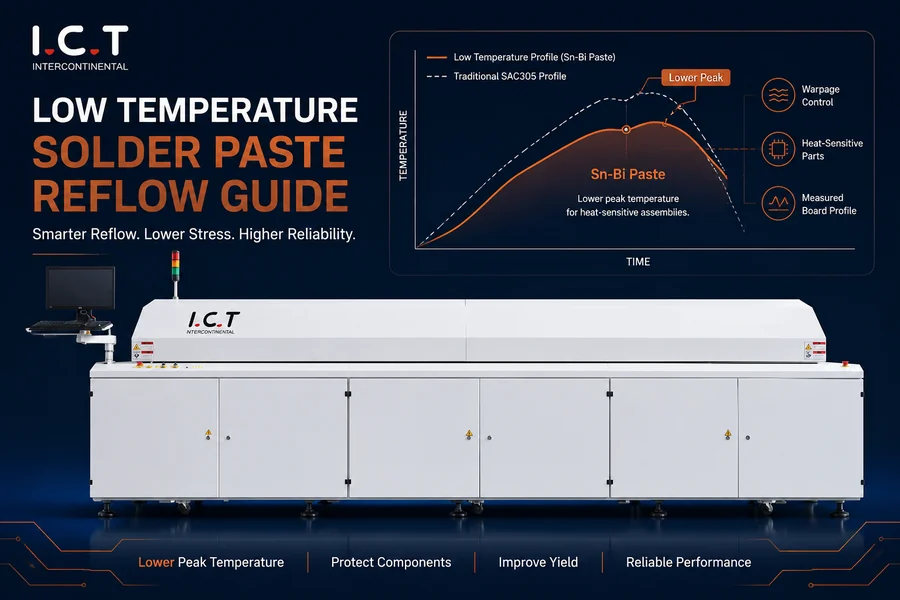
Low temperature solder paste reflow is useful when the assembly needs less thermal stress, less board warpage, or lower peak temperature than a standard SAC lead-free process. It is not a simple drop-in replacement for SAC305. The alloy system, flux chemistry, component limits, board design, reliability target, and actual measured profile all decide whether low temperature SMT soldering is a good choice. If you need the wider lead-free process context first, this complete lead-free reflow soldering guide explains how solder paste, oxidation, thermal profiles, and production control fit together.
For production teams, the practical question is not only “how low can the peak be?” The better question is “can the real PCB reach full wetting at a lower temperature while still meeting reliability requirements?” A stable platform such as a 10-zone reflow oven for SMT production gives engineers more room to control ramp, soak, peak, cooling, and temperature uniformity when low temperature paste is used on mixed thermal mass boards. This guide explains how low temperature solder paste reflow works in factory terms. It covers bismuth solder reflow profile thinking, when low temperature SMT soldering makes sense, what risks should be checked before release, and how to tune the process when wetting, voiding, tombstoning, or brittle joint concerns appear.
Start With the Short Answer: Low Temperature Reflow Is a Process Choice, Not a Shortcut
The lower peak is only one part of the decision
Low temperature solder paste can reduce the reflow peak compared with a standard SAC process. That can help heat-sensitive parts, thin boards, large panels, and assemblies that show warpage during normal lead-free reflow. But the lower temperature does not automatically make the process easier. It changes the alloy behavior, wetting margin, mechanical properties, and defect response.
The best result comes when the engineering team treats low temperature paste as a controlled process window. The paste supplier’s data sheet gives the starting range, but the actual PCB must still be measured with thermocouples and released against the product’s quality requirements.
Low temperature SMT soldering needs reliability screening
Many low temperature solder pastes are based on tin-bismuth or modified tin-bismuth systems. Bismuth can support a lower melting range, but it may also change joint behavior under drop, vibration, bend, thermal cycling, or mixed-alloy conditions. This does not mean low temperature solder is bad. It means the use case matters.
A consumer product with warpage-sensitive components may benefit from a lower thermal process. A high-shock or high-reliability product may need stronger validation before release. The process engineer should not decide from peak temperature alone.
Compare it with the standard lead-free baseline
Before switching to low temperature paste, document the baseline lead-free profile and the defects it is trying to solve. If the current problem is poor SAC305 profiling, bad paste handling, or uneven oven loading, switching alloy may hide the root cause instead of fixing it.
If your team needs to compare the normal SAC process first, this SAC305 reflow profile guide explains the conventional lead-free thermal window. For profile setup sequence across lead-free products, this guide on how to set a lead-free reflow temperature profile is also useful.
If the project is still at the material-selection stage, it also helps to review how lead-free and leaded reflow soldering differ before deciding whether the real problem is alloy temperature, process control, or product reliability.
What Low Temperature Solder Paste Changes in SMT Assembly
The alloy system changes melting behavior
Low temperature solder paste usually melts at a lower temperature than SAC305, but there is no single universal low temperature profile. Some pastes use eutectic or near-eutectic tin-bismuth behavior. Others use modified alloys designed to improve ductility, wetting, or reliability. The exact melting range, recommended peak, and time above liquidus must come from the solder paste supplier.
This is important because two low temperature pastes can behave differently even if both are described as bismuth solder. One paste may wet well at a certain peak temperature, while another may need a different ramp, soak, or time above liquidus to activate the flux system correctly.
Flux activation still needs enough heat
A lower peak does not remove the need for flux activation. The paste still has to remove surface oxides, support wetting, and allow the solder to form reliable joints. If the profile is too cold or too short, the solder may melt but not wet consistently.
This is one of the most common mistakes in low temperature SMT soldering. Teams reduce the peak and conveyor exposure aggressively, then see non-wetting, grainy joints, solder balls, or uneven spread. The process did run cooler, but it did not give the flux and alloy enough useful time to work.
Mixed solder systems need special attention
Low temperature paste may be used with component terminations, BGA balls, or previous solder deposits that were originally designed around SAC alloys. When low temperature and higher-temperature alloys interact, the final joint can have a mixed composition. In some cases, this may be acceptable. In other cases, it can create weak or unpredictable joint behavior.
This is especially relevant for BGAs, rework, step soldering, and products that combine different solder histories. Do not assume the paste alloy alone defines the final joint. The complete solder system defines it.
How to Set a Low Temperature Reflow Profile
Start from the paste supplier’s window
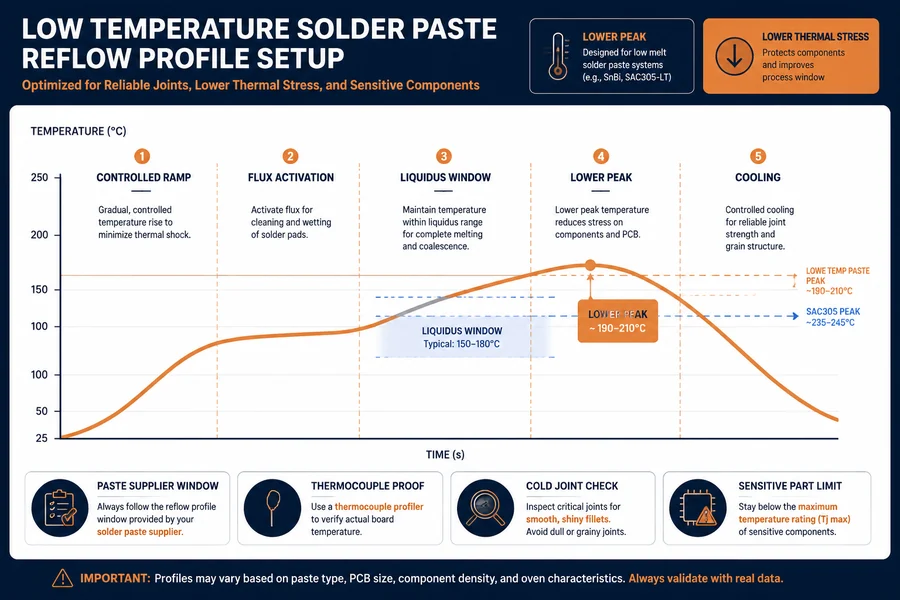
The first profile should come from the paste supplier’s recommended ramp, preheat, time above liquidus, peak temperature, and cooling range. Generic numbers are not enough because low temperature paste chemistry varies widely. The supplier’s window should then be checked against component maximum temperatures, board laminate limits, package sensitivity, and product reliability requirements.
For a new product introduction, record the target window before changing oven setpoints. This keeps the first recipe from becoming a trial-and-error exercise. The engineer should know what the actual board profile must prove.
Control ramp without shocking the assembly
The ramp stage brings the PCB from ambient temperature toward flux activation and solder melting. If the ramp is too fast, the assembly may experience thermal stress, paste spatter, tombstoning tendency, or uneven heating. If the ramp is too slow, the flux may spend too much time in an active region before the solder is ready to wet.
Low temperature reflow often tempts teams to run a very short recipe because the peak is lower. That can work only when the board response and paste window support it. The better practice is to shape a controlled ramp that gives the paste and assembly enough time to stabilize.
Use soak only when it solves a real balance problem
Soak can help reduce temperature differences across the board before reflow. This matters on large panels, dense component groups, shields, connectors, thick copper, or mixed package assemblies. A stable soak can help the coldest areas reach the useful process window without overheating lighter areas.
The risk is over-soaking. Excessive soak can weaken flux activity before the solder fully wets. For low temperature paste, the window can be narrower than expected because the lower peak leaves less extra heat margin. Use soak to solve thermal imbalance, not as a fixed habit copied from another paste.
Time above liquidus must match the actual alloy
Time above liquidus is still critical in low temperature solder paste reflow. The solder needs enough molten time to wet pads and component terminations. Too little time can create incomplete wetting, weak spread, or open joints. Too much time can increase oxidation, intermetallic growth, or thermal exposure, depending on the alloy and assembly.
The correct liquidus point and TAL target depend on the specific paste. Do not use SAC305 values for a low temperature paste. Measure the actual PCB and review the coldest critical joint and hottest sensitive part just as you would in a normal lead-free process.
Peak temperature should be low, but not barely enough
The peak should be high enough above the paste’s melting range to create reliable wetting across the coldest joints. If the peak barely clears the minimum, the process may pass on one board and fail when board loading, oven condition, or room temperature changes.
At the same time, the peak should not be pushed upward without reason. If the process needs a much higher peak than expected, review paste selection, board solderability, component finish, oven heat transfer, and thermocouple placement before simply raising the recipe.
Where Low Temperature SMT Soldering Makes Sense
Heat-sensitive components and materials
Low temperature solder paste can help when the assembly contains components, connectors, labels, plastics, batteries, sensors, camera modules, displays, or other materials that do not tolerate a standard lead-free thermal cycle well. Lower peak exposure can reduce discoloration, deformation, or function risk.
This does not remove the need to check component documentation. Some parts are sensitive not only to peak temperature but also to moisture, ramp rate, or time at elevated temperature. A lower profile helps only if it matches the component’s real limit.
Board warpage and package coplanarity problems
Thin PCBs, large panels, uneven copper distribution, and some package styles can warp during a high-temperature reflow cycle. Warpage can create opens, head-in-pillow, component skew, or poor coplanarity. A lower thermal profile can reduce the stress that drives these problems.
This is one of the strongest use cases for low temperature SMT soldering. The process should still be verified on the actual panel. If warpage is caused mainly by board design, panel support, fixture issues, or uneven conveyor heating, low temperature paste may reduce the symptom without fully solving the manufacturing problem.
Step soldering and secondary assembly
Low temperature solder paste can be useful for step soldering, where the first solder joints must remain stable while a second soldering process is performed at a lower temperature. It can also be relevant for certain rework or module assembly cases where the surrounding structure should not see a full SAC-style reflow again.
In these applications, mixed-alloy interaction deserves careful review. The engineer should confirm that the second solder material will not create unreliable joints with the first solder system or nearby terminations.
Energy and thermal load reduction
A lower peak temperature may reduce oven thermal load and shorten heating demand in some production situations. It can also reduce heat exposure to carriers, fixtures, and operators’ surrounding process environment. However, energy saving should not be the first reason to change solder alloy.
The primary reason should be product and process fit. If low temperature paste is selected only to reduce energy cost, the factory may accept reliability and material-management risks that outweigh the savings.
Process Risks You Should Review Before Release
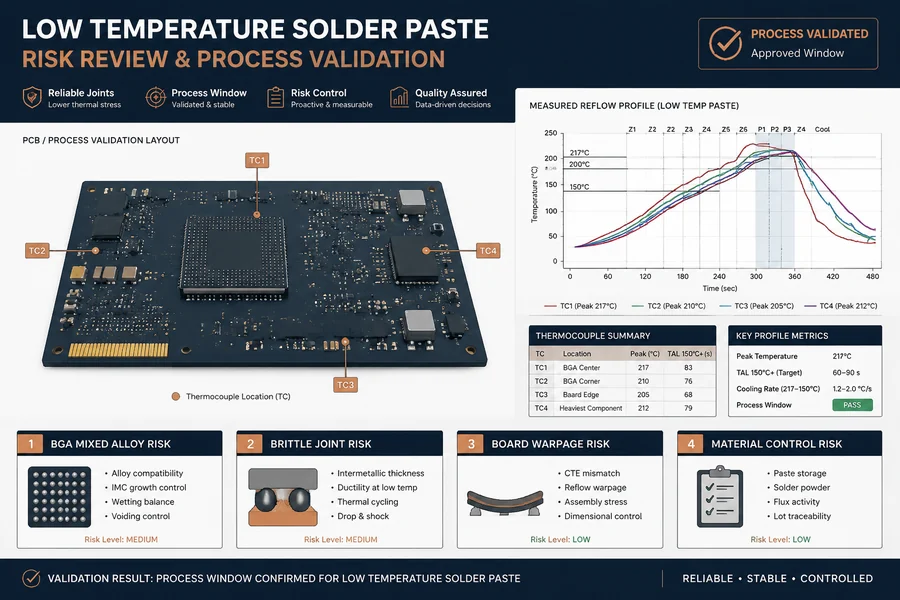
Brittle joint behavior and mechanical stress
Tin-bismuth based solder joints can behave differently from SAC joints under mechanical stress. Depending on alloy, product design, and operating environment, brittleness, drop shock sensitivity, bend stress, or vibration response may become a concern. This is why reliability screening matters before full release.
For products exposed to impact, frequent handling, connectors, large components, or flexing boards, review mechanical test requirements early. Do not wait until production defects force a late material change.
Thermal cycling and operating temperature
Low temperature solder is not automatically suitable for every operating temperature range. If the product will see high ambient temperature, repeated thermal cycling, or temperature gradients, the solder joint behavior must be validated. The solder’s melting range, mechanical properties, and intermetallic behavior matter.
The process engineer should work with quality and design teams to define the product’s real environment. A low temperature paste that performs well in one product category may not be appropriate for another.
BGA and mixed-alloy risk
BGA components need special attention because solder balls may be SAC-based while the paste is low temperature. The final joint can become a mixed alloy, and the collapse, wetting, and microstructure may not match either material alone. Head-in-pillow and incomplete mixing can also be concerns if the thermal profile is not compatible.
If the product contains BGAs, QFNs, bottom-terminated parts, or fine-pitch components, profile measurement should include those areas. Inspection may need X-ray or cross-section support when reliability risk is high.
Material control and line segregation
Low temperature solder paste should not be mixed casually with standard SAC paste on the production floor. Paste storage, labeling, stencil use, printer setup, cleaning, and rework materials must be controlled. A wrong paste or wrong rework wire can create a joint that no one intended.
This is a practical factory risk. The material itself may be good, but line discipline must prevent accidental cross-use. Clear labeling and operator training matter as much as the oven profile.
How to Troubleshoot Low Temperature Reflow Defects
Poor wetting needs profile and material review
Poor wetting can come from insufficient peak, short time above liquidus, weak flux activation, oxidation, expired paste, poor storage, contaminated pads, or incompatible surface finish. The oven profile should be checked, but it should not be blamed automatically.
Start by comparing defect location with measured temperature data. If the problem appears mainly on heavy areas, the coldest joints may not be reaching the useful window. If the problem appears across the whole board, review paste handling, open time, board cleanliness, and surface condition.
Tombstoning often points to heating imbalance
Tombstoning occurs when one side of a small passive component wets before the other side. Low temperature paste can still tombstone if the ramp is too aggressive, pad design is unbalanced, paste volume is uneven, or one side of the component reaches molten behavior earlier than the other.
Profile tuning may involve a gentler ramp, improved soak balance, conveyor-speed changes, or better airflow control. But do not ignore stencil design, placement accuracy, and component termination quality. Tombstoning is rarely a one-variable defect.
Voiding and solder balls need a controlled preheat
Voiding and solder balls may be influenced by paste chemistry, outgassing, stencil design, contamination, and profile shape. A low temperature profile that is rushed can trap volatiles or fail to stabilize paste behavior before reflow. A profile that is too long can also reduce flux effectiveness.
Review defect position and compare it with the thermal curve. If voiding is concentrated under large pads or bottom-terminated parts, stencil aperture design and outgassing path may matter. If solder balls are widespread, paste condition, printing, and preheat behavior deserve attention.
Opens and head-in-pillow need real measurement
Opens and head-in-pillow defects can appear when the solder does not fully wet or merge with the component termination. In low temperature reflow, this may happen if the profile is too cool for the local thermal mass, if BGA balls do not interact well with the paste, or if package warpage changes contact during reflow.
The right response is measurement, not guesswork. Place thermocouples on risk areas, review X-ray evidence, and confirm whether the coldest critical locations actually match the paste supplier’s process window.
What Oven Capability Helps Keep the Process Stable
More zones help shape a lower-temperature curve
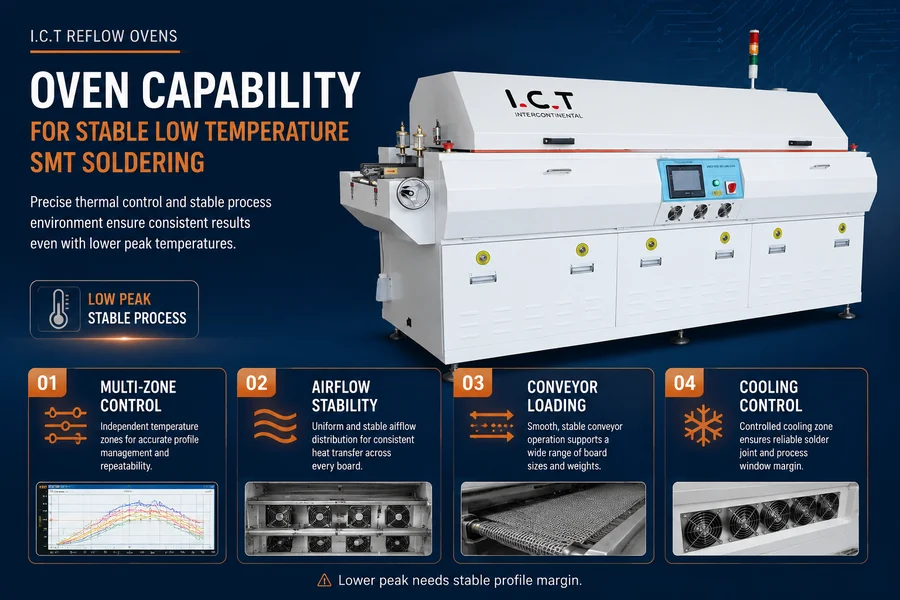
Low temperature reflow still benefits from good oven control. More zones can help shape ramp, balance, peak, and cooling without forcing abrupt transitions. This is useful when a board has both heavy areas and heat-sensitive parts.
A short or unstable oven may run low temperature paste, but it can leave less room for correction. A stable multi-zone oven lets the engineer tune the curve more carefully and repeat it across production lots.
Airflow and loading affect the measured board profile
Zone setpoints are not the same as the board temperature. Airflow stability, top and bottom convection, conveyor speed, exhaust, filters, and production loading all affect the measured profile. A low temperature process can be more sensitive to these details because the thermal margin is smaller.
After major maintenance, loading changes, fixture changes, or product-family changes, recheck the profile. The recipe file is not enough evidence by itself.
Cooling control protects final joint behavior
Cooling can affect joint formation, board stress, and production handling. For low temperature solder paste, the cooling recommendation should come from the paste supplier and product requirement. Too slow may keep the assembly hot longer than needed. Too aggressive may add stress to certain boards or packages.
The goal is a repeatable full curve. Ramp, soak, liquidus, peak, and cooling should work together instead of being tuned as separate numbers.
Nitrogen can support wetting margin when oxidation is a problem
Many low temperature soldering processes can run in air, but nitrogen may help when oxidation reduces wetting margin, fine-pitch joints are sensitive, or cosmetic and reliability expectations are strict. Nitrogen is not a substitute for a correct profile, but it can improve process margin in selected cases.
For factories evaluating atmosphere control and fine profile stability, a Lyra733 nitrogen SMT reflow oven can be relevant when low temperature paste, oxidation control, and repeatable lead-free process windows are part of the equipment decision.
Need Help Validating a Low Temperature Reflow Process?
Talk with our engineers about board mix, solder paste selection, oven zones, nitrogen options, and profile validation before you release production.
Final Takeaway
Release low temperature solder paste only after the real board proves it
The short answer is this: low temperature solder paste reflow can reduce thermal stress, warpage, and peak temperature, but it must be selected and validated as a complete process. Start from the paste supplier’s window, measure the real PCB, check the coldest joints and hottest sensitive parts, and review reliability risks before production release.
Low temperature SMT soldering is strongest when it solves a real product problem. It is weakest when it is used as a shortcut around poor profile control or weak material discipline. When alloy selection, paste handling, oven control, and reliability screening are aligned, low temperature reflow can become a stable production tool instead of a risky experiment.
Frequently Asked Questions
What is low temperature solder paste?
Low temperature solder paste is a solder paste designed to melt and reflow at a lower temperature than standard SAC lead-free paste. Many versions use tin-bismuth or modified tin-bismuth alloy systems, but the exact melting range and profile depend on the supplier. It is useful for heat-sensitive components, warpage reduction, step soldering, and selected SMT processes. Always validate the paste on the real assembly before production release.
What is a typical bismuth solder reflow profile?
A typical bismuth solder reflow profile depends on the exact alloy and flux system, so there is no universal setting. The process should start from the paste supplier’s recommended ramp, soak, liquidus, peak, TAL, and cooling window. The measured PCB profile must then prove that the coldest critical joints fully wet while sensitive components remain within safe limits. Do not copy SAC305 profile values into a low temperature process.
Is low temperature SMT soldering reliable?
Low temperature SMT soldering can be reliable when the alloy, product environment, board design, and profile are properly validated. The main concern is not the low temperature itself, but whether the solder joint can meet the product’s mechanical, thermal cycling, vibration, and operating temperature requirements. Tin-bismuth based joints may need extra review for drop shock, bend stress, and mixed-alloy behavior.
Can low temperature solder paste replace SAC305?
Low temperature solder paste should not be treated as a universal SAC305 replacement. It can solve specific problems such as warpage, thermal stress, and secondary soldering, but it may introduce different reliability and material-control risks. Use it when the product has a clear reason for lower temperature processing, then validate the solder joints, component compatibility, and production controls before full release.
Does low temperature solder paste need nitrogen reflow?
Low temperature solder paste does not always need nitrogen reflow. Many assemblies can run in air when solderability, paste handling, and profile control are stable. Nitrogen becomes more useful when oxidation reduces wetting margin, fine-pitch joints are sensitive, or cosmetic and reliability expectations are strict. Treat nitrogen as a process-margin tool, not a replacement for correct profiling and material control.
Talk to Our Engineers
Tell us about your board mix, solder paste target, throughput target, and reflow profile questions. Our team can help you narrow down the right setup.


